Absurd Creation
The Myth of SisyphusAbsurd Creation names the artistic response to a world in which explanation fails, hope threatens to become evasion, and no work can provide a final meaning or consolation. Creation is not an escape from the absurd but one of its clearest manifestations: a lucid intelligence makes contact with the concrete, multiplies experience through form, and accepts that the result has no guaranteed future. The creator’s dignity lies in sustaining that tension rather than resolving it.
Definition and Ground
The absurd creator belongs to the same godless universe as the conqueror, the actor, and the person who lives without appeal. These figures do not deny the world’s contradictions or retreat into a promised future. Their fidelity consists in enduring the world’s absurdity without pretending that it can be overcome by a final explanation. Creation is described as the absurd joy par excellence because it makes this endurance active: art becomes a way of breathing with the absurd, recognizing its lessons, and recovering them in lived form.
This activity begins after discovery and indifference. The absurd discovery produces a pause in which later passions can be prepared, but the creator is not required to solve what has been discovered. The task is instead to experience and describe. Even when science reaches the limit of its explanations, the world remains available in its inexhaustible diversity; its attractions arise not from a hidden depth that must be decoded but from the variety of its appearances. Art occupies this interval between the refusal of explanation and the persistence of sensation.
Creation as Repetition and Multiplication
The work of art marks both the death of an experience and its multiplication. It repeats, with passionate monotony, the themes already orchestrated by the world: the body, forms and colors, number, and grief. Such repetition does not simply reproduce an original event. It fixes the adventures of consciousness and allows them to be encountered again in altered arrangements. Creating is therefore living doubly, because the creator experiences life and then recreates its forms without claiming that the recreation possesses a higher or eternal significance.
This doubled life extends beyond the finished artwork. The anxious, meticulous collecting of flowers, wallpapers, and anxieties associated with Marcel Proust is presented alongside the continual, almost imperceptible creation practiced by the actor, the conqueror, and other absurd figures. Each mimes, repeats, and recreates the reality that belongs to him. Existence becomes a vast mime for the person turned away from the eternal, and creation becomes the great mime: not a counterfeit that conceals truth, but an activity through which a person acquires the appearance of his truths.
The work is thus not a symbol or a refuge for an intellectual ailment. It remains an absurd phenomenon and a symptom of the same condition it reflects. Yet it also forces the mind outside itself and places it in relation to others, not so that it will lose itself, but so that the shared blind path may become visible. Creation follows indifference and discovery; it is the point at which absurd passions begin and at which philosophical reasoning stops.
The Absurd Work and Its Limits
An absurd work requires lucid thought, but that thought must not appear as a doctrine imposed on the material. It functions as regulating intelligence rather than as an explicit system. The work is born when intelligence refuses to reason the concrete into something more than it is. Lucidity provokes creation, then restrains itself: it rejects the temptation to attach a deeper meaning that it knows to be illegitimate. The work consequently embodies a drama of intelligence indirectly, through the discipline of refusing false depth.
The concrete in such art signifies no more than itself. The work cannot become the end, meaning, or consolation of a life. Creating or not creating changes nothing at the level of ultimate fate, and the absurd creator need not prize the result; he may even repudiate it. The example of Rimbaud, for whom an Abyssinia suffices to mark such repudiation, reinforces the separation between artistic production and any demand that the artist remain permanently faithful to a particular work.
The true work of art is also said to remain on the human scale. It says “less,” offering a piece cut from experience rather than attempting to compress an entire life into explanatory literature. The contrast is drawn through Wilhelm Meister and Johann Wolfgang von Goethe’s maturity: a work is fecund when it presents a facet of a larger experience whose richness remains implied, but overloaded and pretentious when it claims the eternal whole. The absurd artist must acquire a way of living that exceeds mere technical competence, allowing the work to suggest abundance without pretending to master it.
Negative Wisdom and the Creator’s Discipline
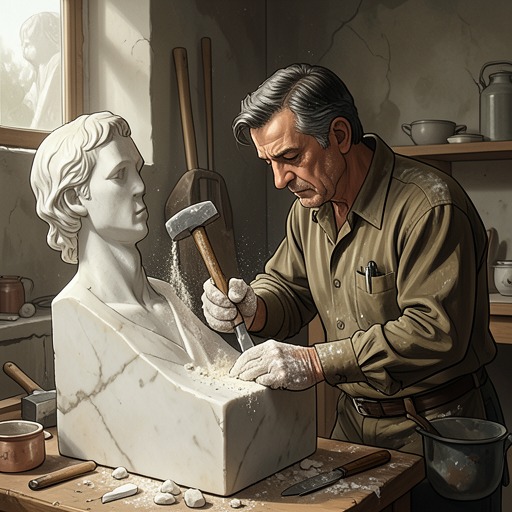
Art is best served by a negative thought because the work’s dark, humiliated procedures are as necessary to understanding it as black is to white. The absurd creator works and creates “for nothing,” shapes clay while knowing the creation has no future, and accepts the possibility that the work may be destroyed in a day. Building for centuries has no fundamentally greater importance than building briefly when both acts are placed against the same absence of ultimate guarantee. This is not indifference to effort; it is a difficult wisdom that refuses to measure creation by permanence alone.
The creator must perform two apparently opposed tasks at once: negate and magnify. The void is not filled with a discovered metaphysical content, but given colors. A creator’s work is therefore not an isolated testimony. A profound thought remains in a state of becoming, taking the shape of a life; successive works complement, correct, surpass, or contradict one another. Creation ends not with the triumphant claim that everything has been said, but with the death of the creator, which closes the course of the experience and the book of genius.
That labor may remain invisible to the reader, yet it is not mysterious. Will performs the work of sustaining creation, while the absence of a final secret does not make creation shallow. Some creators approach one thought through successive approximations; others proceed by juxtaposition, producing works that seem unrelated or even contradictory. Diversity is not a defect within this framework. Thought that abandons unity liberates the mind by leaving it conscious of its limits and impending end, while art makes diversity its natural home.
Revolt, Freedom, and Futility
Absurd Creation is required to embody revolt, freedom, and diversity. Its daily discipline joins intelligence to passion, and its diligence, doggedness, and lucidity resemble the attitude of the conqueror. To create is to give shape to one’s fate. The creator’s work defines him at least as much as he defines it, and the actor has already shown that no firm frontier separates being from appearing. Identity is formed through the repeated practice of the role, not preserved behind it as an untouched essence.
Yet the creator must finally become free even of the undertaking itself. The work may be creation, conquest, or love; it must remain possible to acknowledge that it may not be. This recognition does not weaken action. Awareness of life’s absurdity permits a person to enter life with greater excess, and awareness of the work’s futility grants comparable freedom in carrying it out. Outside the single fatality of death, joy and happiness remain forms of liberty because the illusion of another world is what had bound humanity.
The creator’s images therefore belong to the terrestrial rather than the divine. They may take the form of myths, but their depth is no more than the inexhaustible depth of human suffering. This is not the divine fable that distracts and blinds; it is the human face, gesture, and drama in which difficult wisdom and ephemeral passion are gathered. The work neither redeems existence nor abolishes its limits. It makes those limits visible while allowing life to continue its passionate, temporary movement.
Tragic Consciousness and the Wider World
The image of Sisyphus clarifies the creator’s condition. Sisyphus repeatedly raises the huge stone, watches it rush down, and returns to the plain for another ascent. The decisive moment is the descent, the pause in which consciousness enters the cycle. At that point he is superior to his fate and stronger than his rock, because lucidity turns an imposed repetition into a consciously confronted condition. Creation likewise transforms repetition into form without pretending that repetition has ended.
The descent may occur in sorrow or joy. Melancholy arises when memories of earth cling too tightly or the call of happiness becomes too insistent, but crushing truths lose some of their power once they are acknowledged. The example of Oedipus joins ancient tragedy to modern absurd heroism: once he knows his fate, tragedy begins, yet knowledge also reveals the human bond that remains, and he can conclude that “all is well.” Happiness and the absurd are children of the same earth; neither guarantees the other, but neither can be cleanly separated from it.
The same demand for limits governs the contrast between Greek measure and modern Europe’s pursuit of totality. The Mediterranean sun gives tragedy a beauty and suffocating fulfillment unlike the tragedy of fogs, while Europe feeds despair on ugliness and convulsion after exiling beauty. Greek thought balanced shadow with light and understood equity through limits; modern projects place values at the end of action, where they are still becoming, and thereby allow struggles to spread without an established brake. Nature remains as a calm counterforce to the madness of history, reminding humanity that boundaries exist even when it dreams of exceeding them.
The artist differs from the historical spirit precisely through an obligation to recognize limits. The historical spirit seeks to remake the world and tends toward tyranny when it fails to acknowledge constraint; the artist’s passion tends toward freedom because form requires selection, proportion, and attention to what is actually present. Beauty cannot be defended as an isolated ornament, since it depends on human beings and their misfortune, but humanity cannot do without beauty either. The choice of Ulysses for the land of his fathers, and therefore for mortality rather than immortality, gives this fidelity to limits its final image: Absurd Creation remains loyal to the world that exists, even when that loyalty offers no rescue beyond the world itself.